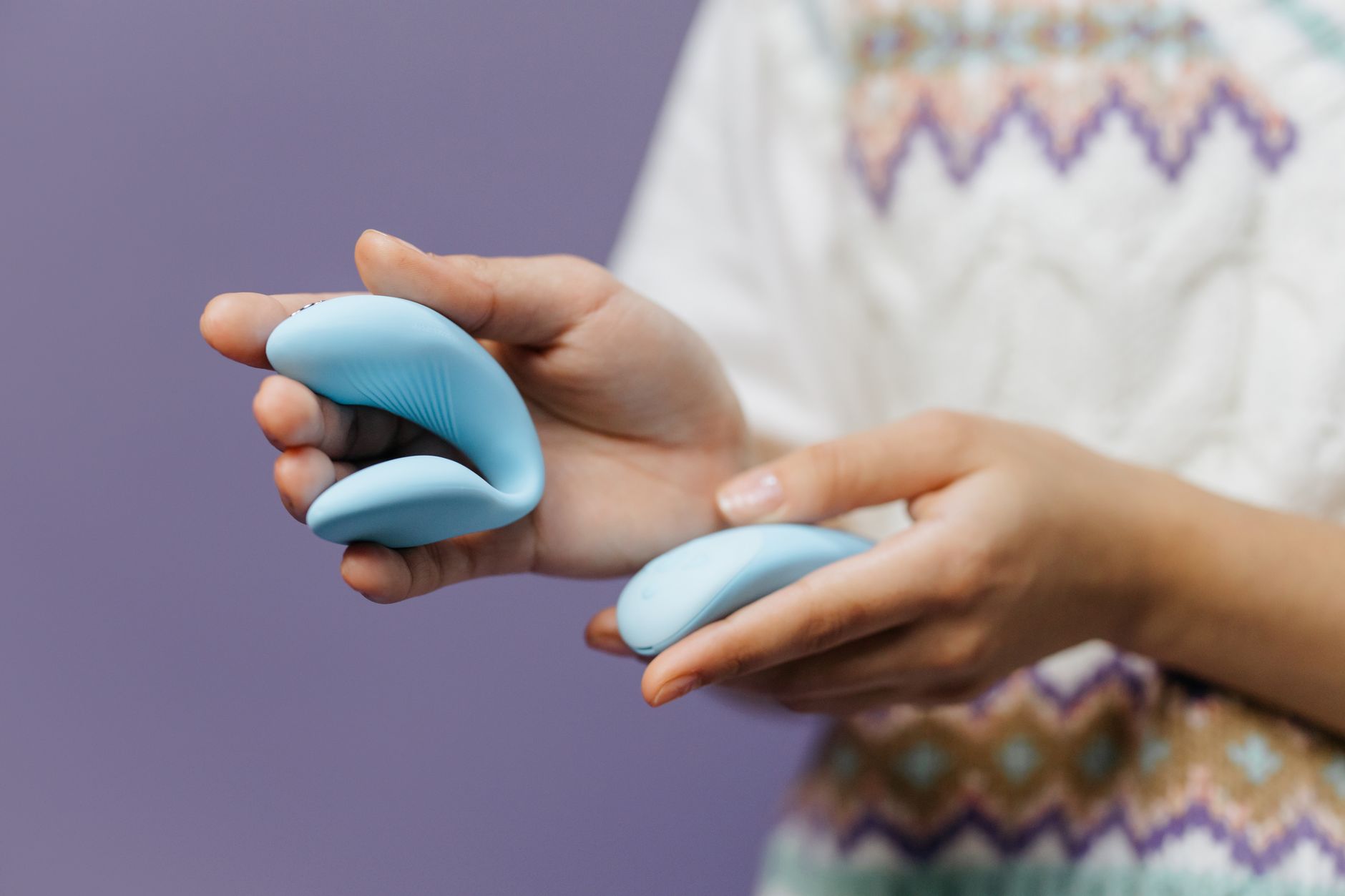
Your partner wants to watch you use a lemon vibrator. That's intimate in a way that's different from the usual naked vulnerability. You're not just exposed. You're exposed and you're feeling good, which somehow feels riskier.
Here's what I tell clients in my office: that risk is actually the pathway to something deeper. Not because you're performing, but because you're willing to let someone see you experiencing pleasure without filtering it. That's trust. And when it works, it changes how couples feel about sex entirely.
Most of what we know about intimacy assumes that sex is something two people do together, in real time, equally. But pleasure doesn't work that way. Your nervous system, your responsiveness, your pace. none of that perfectly mirrors your partner's.
When you use a lemon vibrator solo while they watch, something shifts. They get to see what actually turns you on. Not what you think turns them on. Not what you've been performing for the last five years. The real thing.
For partners, this is revelatory. It's the difference between knowing your partner has an orgasm and actually watching the specific micro-expressions, sounds, and rhythm that gets them there. That information is gold. It's also vulnerable. That's the whole point.
Before any of this happens, you need to talk. Not "do you want to watch me," but the actual infrastructure underneath.
Here are the questions that matter:
On positioning: Do you want them close or across the room? Looking at your face or your whole body? Some people find close proximity grounding. Others find it paralyzing. There's no right answer, but knowing which one you are changes everything.
On the pressure to perform: This is the big one. Are you going to orgasm on command, or are you just exploring while they're there? Because if you set an expectation of "I'll come in five minutes" and it takes fifteen, suddenly the energy gets weird and effortful. Better to say "I might not orgasm and that's okay." Way less pressure.
On eye contact and presence: Do they need to stay quiet? Can they touch themselves? Can they ask questions? All of this changes the experience. A partner who's silently watching feels different from one who's narrating. Neither is bad. Different is different.
On the pause button: You should be able to stop at any time without needing a reason. Not "I'm uncomfortable," just "I want to stop." And they respect that immediately. Full stop.
This conversation happens with clothes on, in daylight, sitting down. Not in the moment. That distinction matters.
A lemon clitoral vibrator feels different than penetrative sex when someone's watching. The sensations are concentrated. The focus is entirely on your pleasure. There's no reciprocal stimulation happening. That's where the vulnerability sharpens.
With a lemon vibrator, you're not managing their experience. You're not adjusting depth or rhythm to sync with theirs. You're just finding what feels good for your body. And that, paradoxically, is more intimate than synchronized movement.
Start at a lower intensity level. Pattern 1 or 2. Not because you need to ease in, but because lower intensity lets you actually feel the sensations and respond naturally. High intensity sometimes locks your nervous system into pure reaction mode. You miss the nuance. And nuance is what your partner is actually there to witness.
Let yourself make sound. Yes, I know that's weird when someone's watching. Do it anyway. Sound is part of your actual pleasure signature. Your partner needs to see the full version, not the muted version.
Here's what happens in your head when someone watches: you fracture. Part of you is feeling the sensation. Part of you is narrating your response to yourself. Part of you is wondering if you look weird. Part of you is noticing their reaction.
That fracture is normal. It's not failure. But you can reduce it with a few tools.
Ground in sensation, not performance. Notice three specific things: the exact pressure of the lemon vibrator, the rhythm your body actually wants (not the one you think is sexy), and where you feel the sensation most acutely. Those three anchors quiet the narration.
Let your eyes do what they want. Closed, open, looking at your partner, looking away. Don't choreograph it. Let your body choose. Your eyes close when sensation gets intense. That's not "bad form." That's your actual response. Show them.
Expect the vulnerability wave. Somewhere in the middle, usually around five to ten minutes, you'll feel a moment of "oh my god, they're watching me do this." That moment is the vulnerability peak. It doesn't mean stop. It means you're at the edge of real intimacy. Breathe through it. It passes.
This is the part couples skip, and it's where the actual intimacy lives.
Don't go straight into sex. You don't need to prove the experience was "worth it" by having an orgasm together. Sit with each other. Maybe talk about what you both noticed. What surprised you. What your partner saw in your face or body that they'd never quite registered before.
Many couples report that this slowed down, intentional aftercare is when they feel most connected. Not during the peak sensation, but in the quiet integration after.
If shame creeps in later, name it. That's normal too. You just did something vulnerable with someone you're supposed to trust. The nervous system sometimes second-guesses that decision. Talk about it. Reassure each other. The shame fades faster when it's spoken out loud.
I've worked with couples where watching each other use lemon vibrators became the pivot point in their relationship. Not because the vibrators were magic. Because they finally saw each other's actual pleasure instead of the performance version.
That clarity carries forward. In regular sex, in daily intimacy, in how you talk about desire. Once you've seen someone's real pleasure response, you can't unsee it. And you don't want to.
Start small. Set clear boundaries. Prioritize the conversation before the experience. And remember that vulnerability is not weakness. It's the strongest thing two people can do together.
You might not. And that's completely fine. The goal isn't to perform an orgasm. It's to let them watch you explore pleasure. Some people need anonymity to climax. That's your nervous system doing its job. If that's you, focus on sensation and responsiveness instead. Your partner will see that you're genuinely present, which is what actually builds connection.
Yes, if you normally do. Don't change your actual preferences because someone's there. The experience is more intimate when you're doing exactly what feels right for your body, not what looks right for an audience. Use what you need.
Watch how they treat the broader conversation. Do they respect your boundaries? Do they listen when you say you want to pause? Do they seem genuinely interested in your pleasure, or is the focus on their arousal? A partner with good intentions will make space for your experience to be about you. If they're impatient, dismissive, or pushing, that's information. Trust it.
That's normal. You shared something vulnerable. Your nervous system might need a few hours to process. Talk to your partner about it. Name what felt off. Was it the specific setup? The timing? Something about their presence? The more specific you can be, the more you can adjust for next time. Or you might decide it's not your thing. That's valid too.
Yes, on video call. Same rules apply. Set up the physical space so you can actually see each other clearly. Make sure you're not going to be interrupted. Check your internet stability. The setup matters more with distance because any technical glitch breaks the intimacy. When it works, though, long-distance couples often report this as one of their most connected moments.
Intent and reciprocity. With a partner, there's genuine emotional presence and mutual vulnerability. The focus is on deepening your connection, not performance for an external audience. You're not working for an outcome. You're just being seen by someone you trust. That's the whole distinction.
Pleasure shared is vulnerability made tangible. When you let your partner watch you experience pleasure with a lemon clitoral vibrator, you're not being reckless. You're being brave. And that bravery, when it's met with respect and genuine presence, becomes one of the most sustaining parts of a long-term relationship.
If you want to explore this further, talk to your partner. Start the conversation without pressure. And remember: the best version of shared intimacy is the one where both of you actually want to be there, exactly as you are.